'new' survivors
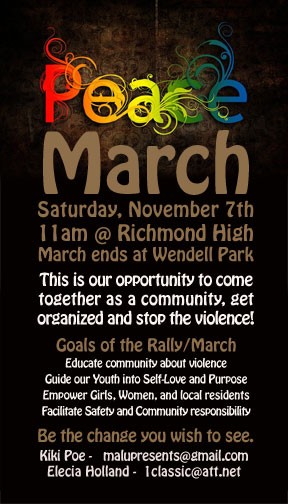 This weekend, a couple of amazing women (thank you Kiki and Elicia!) organized a Peace March and Rally in Richmond, CA, to raise our voices and gather our energies in support of the high school student who was recently raped by a mob of young men -- and, too, to speak out against all sexual violences: against all sexualized violence, against all the messages we teach our children equating masculinity with violence, femininity with passivity, against rape as a weapon of war, against sexualized violence as a part of our every day lives.
After missing the first part of the rally, Fresh! and I got to ride alongside the march for a minute, honking, making a whole lotta noise -- and we were met with the voices and shouts of the marchers! Then he dropped me off and I jogged to catch up with the small march, raised my voice -- it felt good to shout, and I had to cough a couple of times after being so loud: it seems my voice box has grown unaccustomed to loud chanting -- and that's one reason I understood it was good that I was there.
It's been several years, it seems, since I participated in this sort of anti-sexual violence/pro-peace-for-all rally. It's been several years since I walked through quiet neighborhoods and shouted: No Rape! No Rape! Was the last time in Maine? How could that be?
It's not that I haven't gathered, haven't witnessed and participated. The last rally in Richmond, last year, for another gang-rape survivor, was a mostly silent candle-lit vigil. That sort of gathering carries its own weight -- all of our stories, all of our friends' and families' stories, candlit and hungry, sitting just inside our mouths, held and honored and shared in that big big quiet.
I became aware, during the public rage that followed reports of this assault, messages and articles and furious notes I read and listened to online and from friends, of my presence in the aftermath. It's where I live and work: in the aftermath of sexual violence. the workshops I facilitate, the writing I do, it's about the after-story -- what comes next. All the words I use are prefaced with "re-": reclaim, restitution, resurrect. Doing over. Taking back. I don't live anymore in the place of before. Because I can't. My own body is an aftermath.
And so it was that I felt, too, on this Saturday, that our gathering was kind of the saddest sort of welcoming committee for this young woman. She is one of us now. She has a new name: survivor. Victim. The debates bat those words back and forth, but the fact is that she wears them now. Like we do. She has been violently delivered to our side of the battle ground. And we are standing up to show her she is among our kind now; we put our hands around her and we tend her wounds. These wounds are of her now. She lives in and with them. As we do, too.
I don't want this for her. I don't want this for her family or friends. I don't want this for any of us. I want other options. I don't want any more rallies of survivors to have to gather at the gates of the next rape, the next rape, the one happening right now. Right now. Right now. Right now. Right now. I want us to be able to disperse these energies, move on to other work -- raise our voices in praise of love, not in rage and sorrow.
I raged on Saturday, was grateful for all those gathered, and on Sunday I cried. I felt, again, the big, high vision of the hawk that flew over our gathering toward its end: from up high, I can see that this change won't manifest in my lifetime. I won't live to see it. But if I don't continue to hold on to the hope, hold hands open to the possibility that we as humans can learn to relate to and with one another through something besides the veil of violence and rage, then I close one more light shining the way -- does that make sense?
I don't see how we can make the changes we want to make. I don't see how we can get there, when sexualized violence is an ever-present option for men, for women, for anyone in power over any other one. I can't see it. I can't.
But -- here's the but: I stand together with a group of folks who might otherwise pass one another on the street in judgment, we raise our voices too loud, just loud enough for a Saturday morning neighborhood, we listen to one another's words and possibilities, we hear young men and women stating new ways, and I hold my hands open to the change one more time. I let my heart imagine it. I listen to men hold men accountable. I listen to women holding one another accountable. We are accountable to one another or there's nothing left.
If we don't keep working -- which means imagining, which means speaking the possible -- saying, yes, this can change. We can change -- there's nothing for the next generations carrying the torch, lighting the way. Right?
I don't want to be in one more 'welcoming' committee, bringing blankets and hotdish and tea and notebooks and pens and oranges and candles to the newly fallen -- and still, yes, that's where my work is right now.
How do we reframe (there it is again: re: frame) this -- life? This human-ness?
Does this make sense? Tell me what you think --
Labels: aftermath, resources, sexual trauma, solidarity, stories, strength, survivors
posted by Jen Cross @ 11:25 AM
4 Comments


 This has been a hard question for me to answer. I've been slipping between feeling very hopeful and deeply hopeless and heartsick - there are beautiful moments and possibilities and still horrors inflicted in every moment and how can we talk about hope except that without even the mention, the word, I think we lose everything.
 Remember the guidelines of the AWA method writing workshops (as developed by Pat Schneider in her book
 For survivors, those of us--so many of us, in so many different ways--trained into wrongness, trained into silence, trained into the invisibility of our language: when I say that the workshops are “transformative,” I mean that we create ourselves a space in which to alter how we have come to know ourselves through words. When we tell newly-re-framed stories and we are heard... how can that not empower and open the heart?